Water science
Why Seawater Freezes Below 0°C
Salt lowers water’s freezing point. It also helps explain why newly formed sea ice can hold pockets of salty liquid.
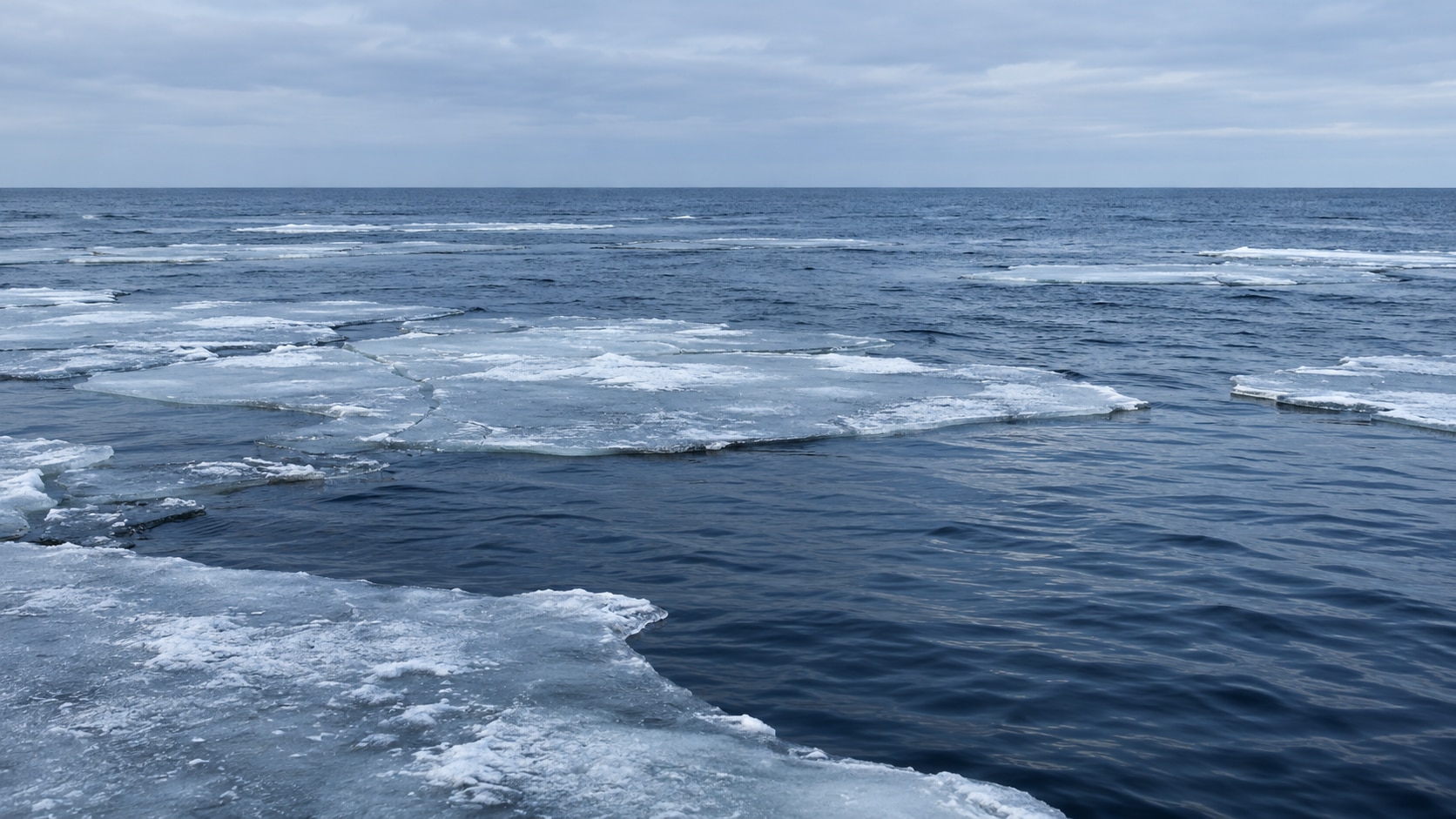
The ocean can remain liquid at a temperature that would usually freeze freshwater. Salt changes the freezing point, so the familiar 0°C mark is not a universal boundary between water and ice.
NOAA’s explanation of ocean freezing gives a useful comparison: freshwater freezes at 0°C (32°F), while seawater freezes at about −1.9°C. Those are ordinary surface-water reference points, not a temperature reading for every stretch of ocean.
More salt moves the freezing point
Salinity describes the concentration of dissolved salts. As salinity rises, water generally needs to become colder before it begins freezing. The National Snow and Ice Data Center explains that seawater’s freezing point varies with its salinity.
That variation matters because the ocean is not equally salty everywhere. Rain and melting ice can freshen surface water; evaporation leaves salts behind and can increase their concentration. NOAA’s seawater guide describes these regional differences.
A rounded seawater freezing temperature is therefore a starting point for understanding the ocean. It is not a fixed setting that every bay, river mouth and open-water region shares.
Ice crystals and brine are different
As seawater begins to freeze, the growing ice crystals largely exclude salt from their structure. Some concentrated salty water, called brine, can become trapped in pockets between the crystals.
NSIDC describes how those liquid pockets can persist because their greater salt concentration lowers their freezing point further. Over time, brine can drain through channels in the ice or be flushed out during melting. The salt content of sea ice can change as it ages.
This is why an ice-covered surface is more complicated than a frozen copy of the water beneath it. The ice crystals, the trapped liquid and the surrounding seawater do not necessarily have the same composition.
Freshwater has its own cooling pattern
Salinity also affects density, which helps determine whether cooling water stays at the surface or sinks. NOAA notes that seawater can keep getting denser as it cools toward freezing. Freshwater instead reaches its greatest density near 4°C, before it freezes.
Our explanation of why ponds freeze from the top follows that freshwater pattern. The ocean adds another variable: dissolved salts change both the freezing temperature and the way cooling water behaves.
When a sea surface remains open below 0°C, the thermometer and the liquid water can both make sense. The freshwater benchmark tells only part of the story.
Editorial · not medical advice