
What Your Carbon Filter Removes, and What It Misses
A carbon filter can be useful, but its performance belongs to a specific model and claim. Check the contaminant, certification, and replacement schedule—not just the word carbon.
Editorial · not medical advice
Updated September 4, 2026.
A pitcher, refrigerator cartridge, and under-sink system may all contain activated carbon. That does not mean they do the same job. Carbon identifies a treatment material; the model's tested claims tell you what to expect from the complete product.
Start there, and a crowded filter aisle becomes easier to navigate.
What activated carbon does
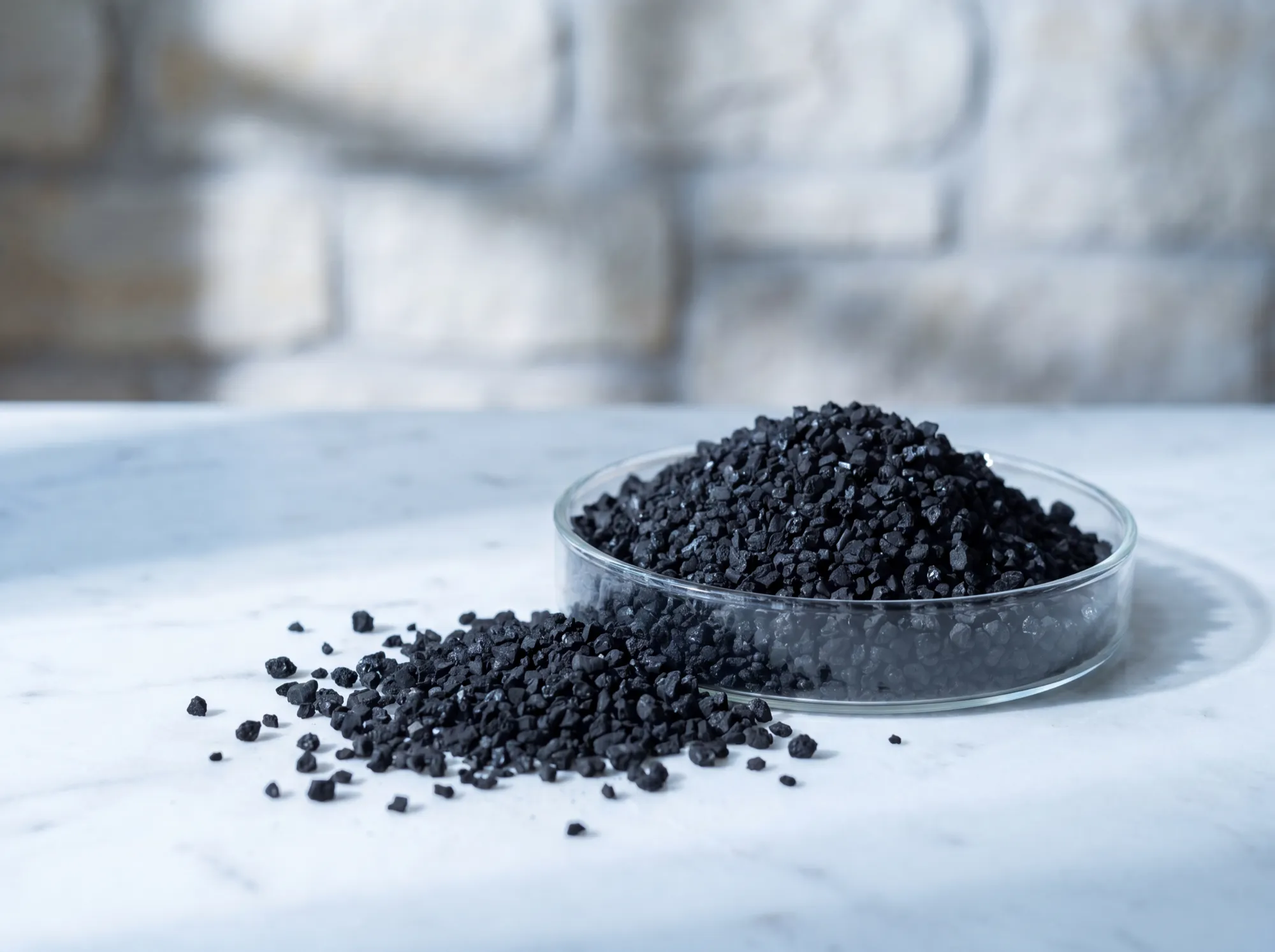
Activated carbon has a porous structure that provides surfaces to which some substances adhere—a process called adsorption. Its effectiveness varies with the substance and the treatment conditions. EPA research on PFAS, for example, describes differences in how readily individual compounds are removed by granular activated carbon. EPA: carbon treatment and PFAS
Many household carbon products are used to reduce chlorine-related taste and odor. Some complete systems also have certified claims for particular health-related contaminants. Neither the word “carbon” nor a more pleasant taste establishes that a filter addresses every concern.
Read the claim, then the standard
NSF explains that certification standards cover different purposes and are not a ranking system. Important examples include:
- NSF/ANSI 42: particular aesthetic claims, such as chlorine taste and odor reduction.
- NSF/ANSI 53: particular health-related contaminant-reduction claims.
- NSF/ANSI 58: reverse-osmosis systems and their applicable performance claims.
Certification to a standard does not mean the product reduces every substance covered by that standard. Find the exact model, replacement cartridge, and contaminant claim in the certifier's listing. NSF: water treatment standards
For example, a chlorine taste-and-odor claim is not a lead claim. A lead claim is not a claim for every PFAS. For PFAS specifically, EPA directs consumers to certified reduction claims and recognizes both carbon-based and reverse-osmosis options. EPA: identifying filters certified to reduce PFAS
Avoid blanket promises about what gets through
A basic carbon material and a multi-stage cartridge are not the same thing. Specialized media or additional treatment stages can change performance. Do not decide whether a system addresses lead, nitrate, fluoride, or another concern solely by its shape or by a generic list of what “carbon filters” remove.
The reverse assumption is equally unhelpful: an under-sink installation is not automatically more appropriate for your particular concern than a certified pitcher. Match the specific evidence to the job.
Maintenance is part of performance
Filters have limited capacity. EPA emphasizes replacing cartridges or membranes according to the manufacturer's instructions; a system's ability to reduce PFAS depends on proper maintenance. EPA: filter maintenance
Before buying, locate the replacement interval or rated volume, the required cartridge, and the maintenance instructions. Put that information somewhere you will actually use it. A certification mark on the original box cannot tell you whether today's cartridge has been maintained correctly.
Start with your water, not someone else's worry
For a public supply, read the utility's annual water-quality report and ask about a specific concern. Local plumbing or a private well may require additional, property-specific information. Your utility, health department, or a qualified water-testing service can help you identify the appropriate question before choosing treatment. CDC: choosing home water filters
Do not judge safety from taste, clarity, or a dissolved-solids reading alone. Nor should a home filter be assumed to override a local drinking-water advisory. Follow the instructions for the specific advisory in your area. CDC: drinking-water advisories
Source depth is not a substitute for evidence
The same discipline applies to bottled water. Recovery's published source depth of approximately 510 meters describes its origin; it does not prove that surface-related contaminants cannot reach that water. Deep-ocean water circulates, and the ocean is not divided by a sealed barrier. NOAA: ocean currents
Our testing summary guide explains how to read the product-specific evidence and its limits. Home treatment and bottled-water testing deserve the same standard of specificity: what was evaluated, for which purpose, and under which conditions?
Correction: The earlier version overstated protection from source depth and presented Standard 53 too broadly. This revision distinguishes model-specific claims, other relevant standards, and maintenance requirements.
More from the Journal
Stewardship
Beverage Packaging Has Entered a New Accountability Era
California and the EU are changing packaging requirements on different schedules. Here is what the rules measure, and what a bottle’s label can actually establish.

Water Science
WHO’s 2026 Drinking-Water Update Looks Beyond the Final Test
WHO’s June 2026 update gives small water supplies more attention and strengthens practical guidance on preventing contamination.