
What a TDS Reading Actually Tells You
A higher number does not mean dirtier water. Here is what the reading on a TDS meter can, and cannot, tell you.
Editorial · not medical advice
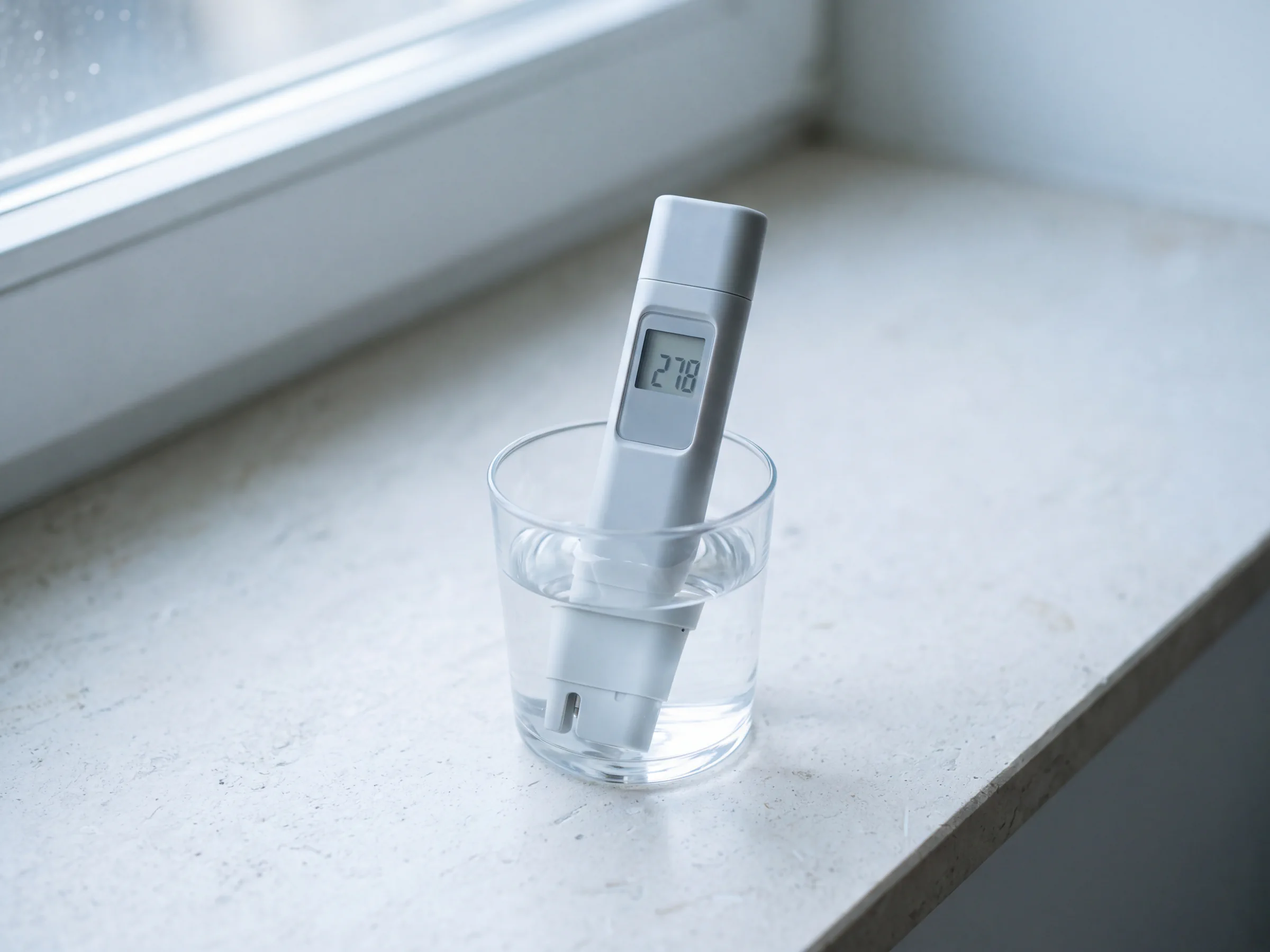
TDS is one of the most misread numbers in water. People buy a cheap meter, dip it in a glass, and treat the result as a purity score. A low number feels clean. A high number feels suspect. The reading does not work that way.
What TDS actually measures
TDS stands for total dissolved solids. It measures the combined concentration of everything dissolved in the water: minerals, salts, metals, and other particles.
The key word is total. A TDS meter adds everything up and returns one number. It does not tell you what any of those solids are. Magnesium and lead both raise the reading. The meter cannot tell them apart.
Why the number alone tells you nothing
Two glasses of water can read the same TDS and be completely different water.
One can be rich in calcium and magnesium, the kind of mineral content people pay a premium for. The other can reach the same reading through sodium, nitrates, or dissolved heavy metals. Same number on the screen. Very different thing to drink.
A TDS reading is a quantity. It is not a quality. Treating it as a safety score is the core mistake.
The 500 figure is about taste, not safety
This is where most of the confusion starts.
The EPA's 500 mg/L figure for TDS is a secondary standard. Secondary standards are non-enforceable guidelines that address aesthetic effects: taste, color, and odor. They are not health thresholds.
In plain terms, the 500 line exists because very high TDS can make water taste salty or metallic, not because crossing it makes water unsafe. Many mineral waters that people specifically seek out sit above it.
What a high reading can mean
A high TDS number can point in two opposite directions, and the meter will not tell you which.
It can mean the water carries a rich profile of beneficial dissolved minerals. It can also mean it carries contamination. The reading is identical either way. The only way to know which is a real analysis that identifies the specific solids, not a number on a handheld meter.
How to read your own water
If you want to understand what is in your water, the meter is the wrong tool. The right one is a report.
- For tap water, read your municipal annual water quality report, which lists specific contaminants and their levels.
- For bottled or specialty water, look for a third-party lab analysis that names minerals and contaminants individually.
- Treat any single TDS number, high or low, as a starting question, not an answer.
Where our number comes from
Unbelievable Water carries a meaningful TDS, and that is the point.
The reading reflects naturally occurring trace minerals drawn from a deep-ocean source, not surface runoff or contamination. The number is higher because the minerals are present, which is the opposite of what a stripped, low-TDS water offers. What matters is not the size of the number. It is what the number is made of.
Source: U.S. Environmental Protection Agency, Secondary Drinking Water Standards, 40 CFR Part 143.
More from the Journal
Stewardship
Beverage Packaging Has Entered a New Accountability Era
California and the EU are changing packaging requirements on different schedules. Here is what the rules measure, and what a bottle’s label can actually establish.
Water Science
WHO’s 2026 Drinking-Water Update Looks Beyond the Final Test
WHO’s June 2026 update gives small water supplies more attention and strengthens practical guidance on preventing contamination.