
The Colorado River Has a New Plan for 2027–2028
New federal guidelines set two years of reduced deliveries while leaving room for a longer agreement. Here is what is required, what is voluntary, and when the changes begin.

Editorial · not medical advice
On August 21, 2026, the U.S. Department of the Interior finalized an operating plan for Lake Powell and Lake Mead for 2027 and 2028. The timing was not abstract. The Bureau of Reclamation reported that the combined contents of the two reservoirs had fallen to their lowest level since before Lake Powell began filling in 1963. Reclamation's decision announcement
The decision supplies a near-term plan where a durable seven-state agreement had not yet emerged. It reduces scheduled deliveries, aims to protect critical dam infrastructure, and creates room for voluntary conservation. The decision is already issued; its operating periods are still ahead.
One calendar distinction matters immediately: Lake Powell's 2027 water year begins October 1, 2026. Lake Mead's stated 2027 delivery reductions apply to calendar year 2027. A plan bearing “2027” in its title does not mean every operational change waits until January. Glen Canyon Dam operating update
What the new guidelines require
Lake Mead deliveries to Arizona, California, and Nevada will be reduced by a combined 1.25 million acre-feet in each of 2027 and 2028. If the Lower Basin states implement their proposed sharing agreement, the listed annual reductions would be 760,000 acre-feet for Arizona, 440,000 for California, and 50,000 for Nevada. The combined reduction is required; that specific state-by-state division is conditional on the sharing arrangement.
The guidelines also provide for the Lower Basin states to voluntarily conserve and store at least 700,000 acre-feet over the two-year period. That additional conservation is separate from the required 1.25-million-acre-foot annual reductions. It should not be described as another mandatory annual cut. Reclamation: required reductions and voluntary conservation
At Lake Powell, releases will respond to actual hydrology and an infrastructure-protection elevation of 3,510 feet. Reclamation's August operating update places water year 2027 in the Low Elevation Infrastructure Protection Range, with an expected release of 6 to 7 million acre-feet. The annual release volume is to be determined in April 2027; the operating update also allows releases outside the expected range following appropriate consultation. These are operational tools, not a guarantee that the reservoir will remain above a particular elevation. Lake Powell operating conditions
An acre-foot is the volume required to cover one acre with one foot of water—about 326,000 gallons. The unit is enormous at household scale and practical at river-basin scale.
Why the reservoirs are this low
Reclamation describes a 26-year drought across the basin. Conditions deteriorated further after record-low snowpack during the winter of 2025–2026. Snow accumulated in the Rocky Mountains is a form of seasonal storage, releasing water into the river system as it melts. Less snow and poor runoff leave less to allocate downstream. Reclamation's decision background
Demand and infrastructure also matter. The Colorado River supplies more than 40 million people, serves 30 Tribal Nations and two Mexican states, supports hydropower, and sustains approximately 5.5 million acres of farmland. Every operating choice therefore moves through legal rights, food production, energy, ecosystems, and communities—not simply a reservoir gauge. Reclamation: basin context
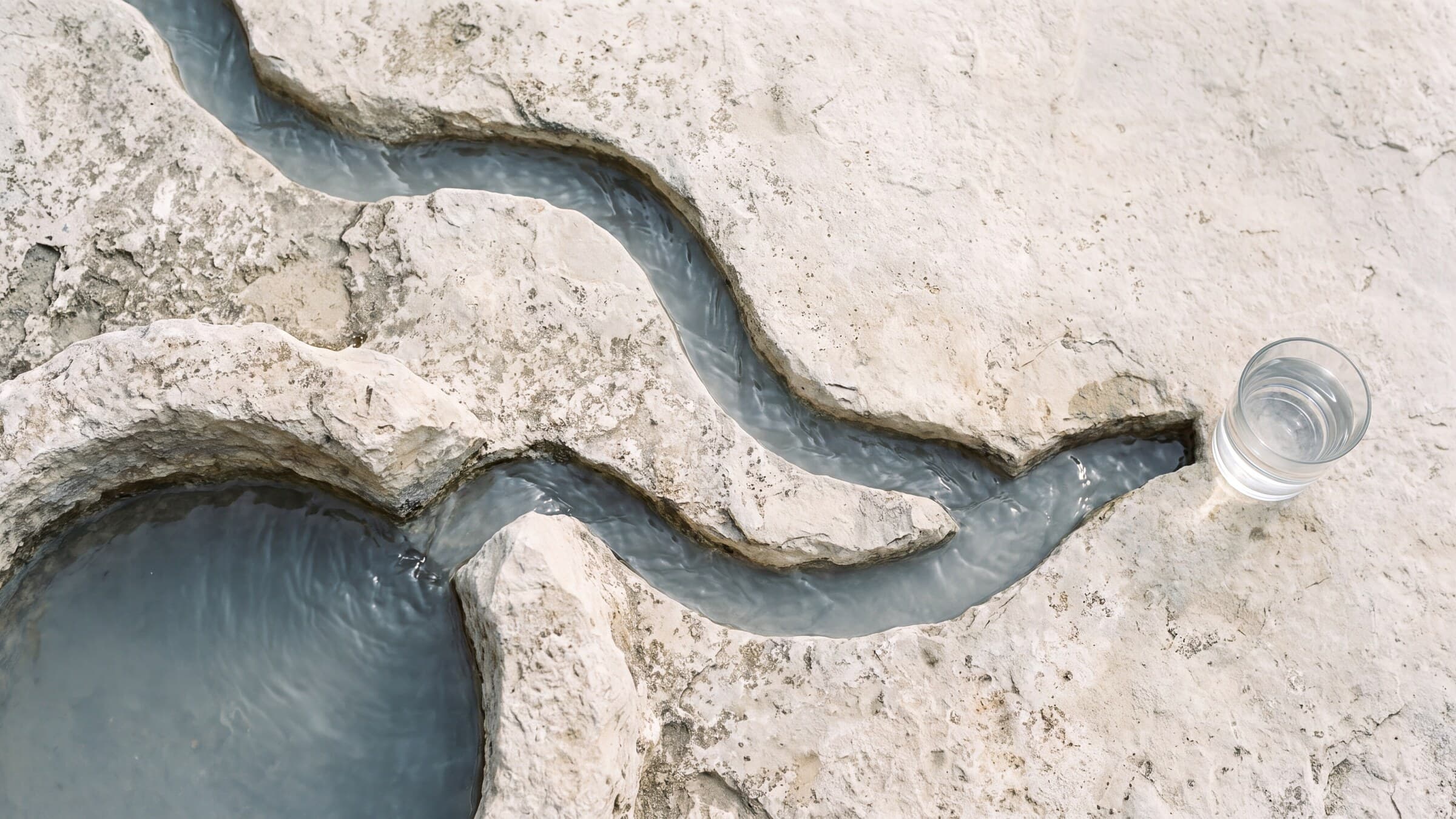
That complexity is why a low-water image cannot explain the river by itself.
A reservoir level is a measurement of storage. A water agreement is a decision about shared risk.
A framework designed to change
The Record of Decision establishes a 10-year framework for 2027–2036, while the first specific operating guidelines cover only 2027–2028. Later guidelines are anticipated to cover two-year intervals unless consensus agreements support a longer period. A decade-long framework is not the same thing as ten years of identical delivery cuts. Decision documents and operating guidelines
That flexibility is intentional. Reservoir operations must work across wet years, dry years, and sequences no single forecast will capture perfectly. The framework leaves space for later agreements among basin states, tribes, and other stakeholders, as well as coordinated reservoir operations and storage of conserved water.
The August announcement described a separate process with Mexico as nearing completion. That status belongs to the dated announcement; it should not be mistaken for a completed binational agreement. For subsequent decisions, consult Reclamation's Post-2026 operations page.
What this means for Arizona
Arizona has the largest listed reduction under the proposed Lower Basin sharing arrangement. That figure does not mean every Arizona household or business receives the same percentage reduction. Water rights, delivery systems, and local supply portfolios differ.
For residents, the useful questions are local: Which provider serves this address? What share of its supply comes from the Colorado River? How is it preparing for 2027? A provider's plan offers a more relevant starting point than applying a basin-wide figure directly to your own tap.
For businesses, the questions are similarly specific. Where does the operation withdraw water? What happens to that water after use? Which local systems and communities share the resource? A national pledge cannot answer those questions on its own.
The bottled-water connection
This river story is relevant to water-dependent companies, but relevance is not the same as direct sourcing. Unbelievable Recovery is sourced from the East Sea off Sokcho, South Korea, at approximately 510 meters; it does not draw from the Colorado River. Choosing a bottle of Recovery should not be understood as an action that restores Lake Mead's storage.
The connection is a standard of conduct. Premium water should be clear about its origin, the evidence behind its product claims, and the water demands associated with its operations and packaging. Our product FAQ distinguishes Recovery from Reserve and explains the limits of their published testing information.
The Colorado River's next era will involve revisions, not one final answer. Transparent measurements, enforceable near-term decisions, and the ability to adjust are practical ways to plan when the future remains uncertain.
Sources
- Bureau of Reclamation: August 21, 2026 operating-guidelines announcement
- Bureau of Reclamation: Record of Decision and 2027–2028 operating guidelines
- Bureau of Reclamation: Post-2026 Colorado River operations
- Bureau of Reclamation: Glen Canyon Dam operating update
Sources checked September 5, 2026. Reservoir projections and operating decisions may change.
More from the Journal

Stewardship
Beverage Packaging Has Entered a New Accountability Era
California and the EU are changing packaging requirements on different schedules. Here is what the rules measure, and what a bottle’s label can actually establish.
Water Science
WHO’s 2026 Drinking-Water Update Looks Beyond the Final Test
WHO’s June 2026 update gives small water supplies more attention and strengthens practical guidance on preventing contamination.