
How to Taste Water Like a Sommelier at Home
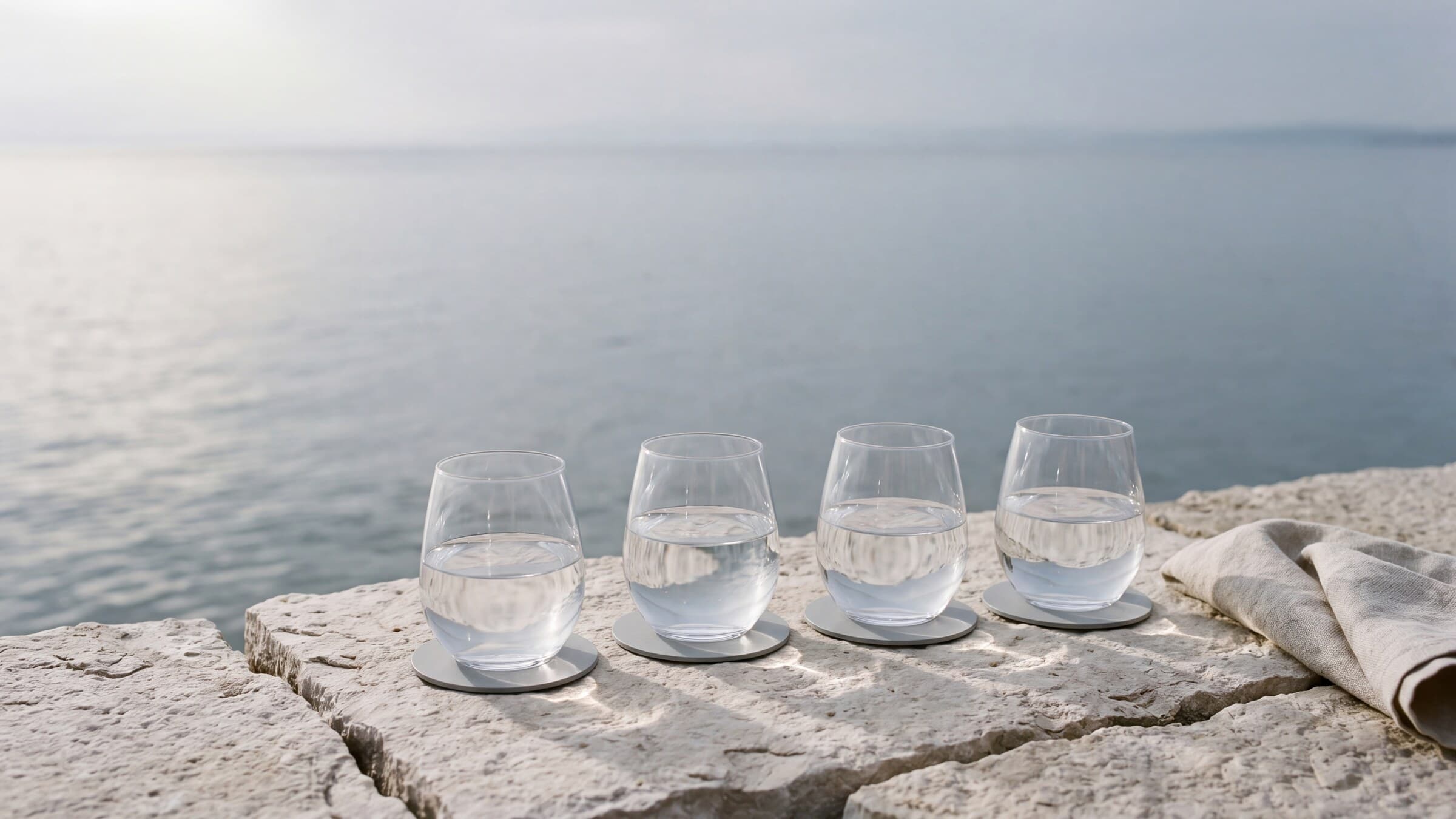
Set up a blind tasting with three or four waters, identical glasses and a scorecard. Compare what you notice before revealing the labels.
Editorial · not medical advice
In a side-by-side tasting, one water may feel light and fleeting while another seems rounder or slightly drying. You may also find that some samples are difficult to distinguish. Record that too; you do not need to find a difference in every glass.
Build a flight with contrast
Ask a helper to choose three or four still, unflavored waters with different published compositions and keep the bottles out of sight. A flight might include a low-TDS purified water, a moderately mineralized bottled water, a more mineral-forward water and your usual tap water if it is safe to drink.
Use only water already suitable for drinking. A tasting is not a safety test: WHO distinguishes sensory acceptability from water safety. Do not taste a questionable source to decide whether it is safe, and follow any local drinking-water advisory.
Have the helper assign each sample a code and keep the key hidden until everyone finishes. Use identical clean glasses, filled to the same level, with the code on a card or coaster beside each one. If you select and pour the waters yourself, covering the labels still removes a visual reminder, but it is not a fully blind comparison.
Rinse glassware thoroughly and let it cool after washing. Avoid scented detergent residue. Serve every sample at the same temperature; around 18–20 °C is our suggested starting point for this home exercise, not a professional standard.
Prepare the space
Choose a quiet space without candles, cooking aromas, perfume or an open bag of coffee. Keep the surface and glassware plain so you can concentrate on the samples.
Give yourself a break from gum, mints, smoking and strongly flavored food beforehand. Between samples, pause rather than switching to a flavored drink. If you need a palate reset, try a small piece of plain unsalted cracker, then wait before continuing.
ISO 13299 describes the broader process of establishing a sensory profile. This informal exercise does not reproduce an ISO protocol or a trained-panel assessment.
Use the same tasting sequence for each glass
- Look. Note clarity and visible bubbles. Appearance may be similar across the flight; that is a useful observation, not evidence of safety.
- Smell. Swirl gently and take a short sniff. There may be very little aroma. Notice whether any additional aroma becomes apparent after a sip.
- Take a small sip. Let it move across the tongue before swallowing. Do not gulp.
- Notice texture. Does it feel lean, round, soft, weighty, silky, brisk or drying? Use the words that make sense to you.
- Wait for the finish. After five to ten seconds, record what remains: mineral, saline, faintly sweet, bitter, metallic, chalky or simply short.
Write short notes and use the same intensity scale for each sample. “Slightly drying, 2 out of 5” gives you something to compare on a second tasting. These are personal descriptions, not laboratory findings.
Separate preference from description
Describing a water and enjoying it are different questions. Copy this scorecard onto paper or into your notes. Use 0 for no noticeable intensity and 5 for strong intensity; rate liking from 1 to 5. Add the date and serving temperature above it.
| Sample | Aroma and first taste | Texture and finish | Intensity, 0–5 | Liking, 1–5 |
|---|---|---|---|---|
| A | ||||
| B | ||||
| C | ||||
| D, if used |
On a narrow screen, scroll the scorecard sideways to see every column. A blank or “no clear difference” is a valid observation.
Research comparing two sets of bottled and tap waters associated panelists’ ratings with measured composition. Those results describe the tested samples and panels, not a universal recipe for the best-tasting water.
A 2013 review of bottled-water composition and flavor also describes how mineral taste depends on the mixture. Calcium, magnesium, sodium and potassium can contribute different impressions depending on concentration and the accompanying anions, such as bicarbonate, chloride and sulfate. TDS gives a combined quantity; it does not identify that mixture.
Reveal the labels after the notes
Once everyone has finished, reveal the waters and compare observations with the published analyses. Look at the individual minerals before reaching for a single-number explanation. Our guide to TDS, hardness, alkalinity and pH explains what each measurement describes.
If a higher-magnesium water seemed more structured in this flight, record the pattern as an observation, not a law. A small home tasting cannot isolate one mineral from everything else that differs between the waters.
Run the flight again with the order changed. On another day, repeat it with all samples chilled. A 1972 drinking-water study reported lower taste intensity after chilling than at room or body temperature. That finding is a reason to compare temperatures, not a guarantee that every flavor will change in the same way.
If Recovery is in the flight, keep it blind until the end too. Then compare your notes with its published mineral profile, remembering that those typical production values can vary by batch. The profile does not dictate what you should taste or whether you should prefer it.
Keep the scorecard for your next tasting. Change one condition at a time, then see which observations repeat.
Sources checked September 24, 2026.
Sources
- ISO 13299:2016 — General guidance for establishing a sensory profile
- Platikanov and colleagues — Influence of minerals on the taste of bottled and tap water. The authors acknowledge Spanish public research funding.
- Marcussen and colleagues — Composition, flavor and consumer preferences of bottled water. PubMed lists support from the ViVa water-research initiative.
- Pangborn and Bertolero — Influence of temperature on taste intensity and liking of drinking water
- WHO — Drinking-water acceptability: taste, odour and appearance
More from the Journal
Water Science
Alkaline Water, Without the Hype
The evidence for alkaline water depends on the outcome studied and the water’s composition. A pH number alone cannot establish a health benefit.
Mineral Science
TDS, Hardness, Alkalinity, and pH Are Four Different Numbers
A quick reference for four water measurements: what they describe, which units they use and where the numbers stop helping.